Mostrando entradas con la etiqueta padres apostolicos. Mostrar todas las entradas

sábado, 25 de julio de 2020

TEORODO DE MESOPUESTIA Y JUAN 20:28

TEORODO DE MESOPUESTIA Y JUAN 20:28

¿Quién fue Teodoro?

“se destaca como una figura influyente bien situada para observar y contribuir a la cristianización del Imperio Romano durante los siglos cuarto y principios del quinto. Nació en una familia acomodada en la ciudad de Antioquía (Antakya, en el sur de Turquía) alrededor del año 350 dc. Fue educado, junto con su contemporáneo más conocido Juan Crisóstomo, en la famosa escuela de retórica antioquena del Líbano. Teodoro luego persiguió una vida ascética junto con el estudio teológico y bíblico fuera de Antioquía bajo Diodoro (d. Ca. 390), más tarde obispo de Tarso. Teodoro sirvió como sacerdote en Antioquía desde 383 hasta que fue ordenado obispo de Mesopuestia en Cilicia (Yakapınar moderno en el sur de Turquía) en 392. Teodoro sirvió como obispo de Mesopuestia hasta su muerte en 428… También escribió varios trabajos defendiendo la teología de los concilios de Nicea (325) y Constantinopla (381) contra el llamado oponente "arriano"”
https://chs.harvard.edu/CHS/article/display/5817.1-theodore%E2%80%99s-life-education-and-ministry

El comentario a continuación está citado de C4T 15 (VT 16) From the Commentary on John14,
The Case Against Diodore and Theodore Texts and their Contexts, John Behr, Pg. 372, 2011:


No existe traducción alguna a nuestro idioma de esta cita, y tampoco encontré alguna en inglés, por lo tanto, la siguiente es una traducción propia del comentario, la cual está corroborada por los comentarios académicos que le siguen:

Tomás expresó lo que habían anticipado: "señor mío y Dios mío", dice, no se refiere al señor y Dios (porque la resurrección es la evidencia que Dios le enseñó el poder de levantarlo nuevamente), sino como un milagro de Dios hecho en su favor.


The Works of Nathaniel Lardner Vol 4, Nathaniel Lardner fue un teólogo inglés, pg. 401, 402, 1838.

““Mi Señor y mi Dios,” [Juan xx. 28.] el no llama a Cristo Señor y Dios: pero asombrado por el gran milagro de su resurrección, y la evidencia completa de ello, que se le había brindado, alabó a Dios, quien había resucitado a Cristo de la muerte. Tampoco el ser resucitado de entre los muertos es una prueba de deidad.” (Traducción propia a nuestro idioma)

Οὗτος δὲ καὶ τὴν ὁμολογίαν Θωμᾶ τὴν ἐπὶ τῇ ψηλαφήσει τῶν χειρῶν καὶ τῆς πλευρᾶς τοῦ κυρίου μετὰ τὴν ἀνάστασιν τό «ὁ κύριός μου καὶ ὁ θεός μου», εἶπε μὴ εἰρῆσθαι περὶ τοῦ Χριστοῦ παρὰ τοῦ Θωμᾶ (οὐδὲ γὰρ αὐτὸν εἶναι λέγει τὸν Χριστὸν θεόν), ἀλλ’ ἐπὶ τῷ παραδόξῳ τῆς ἀναστάσεως ἐκπλαγέντα τὸν Θωμᾶν ὑμνῆσαι τὸν θεὸν τὸν ἐγείραντα τὸν Χριστόν.

"Similarly, that the confession of Thomas, on touching the hands and the side of the Lord after the resurrection, “My Lord and my God,” was not spoken concerning Christ by Thomas (and neither he says that Christ is god), but that, astonished at the miracle of the resurrection, Thomas praised God who raised Christ." 


“There is no other passage in which the word theos is incontrovertibly applied to the Son: even Thomas’s exclamation “My Lord and my God” (John 20.28) is understood by a minority of readers as a prayer of thanksgiving rather than an apostrophe to the resurrected Jesus.”
(An International Journal for Philosophy of Religion and Philosophical Theology, 2020 TheoLogica, Mark Edwards es Profesor de Patrística y Tutor de Teología en la Universidad de Oxford, pg. 3, 2020)

“No hay otro pasaje en el cual la palabra theos sea incontroversialmente aplicada al Hijo: incluso la exclamación de Tomás “Mi Señor y mi Dios” (Juan 20.28) es comprendida por una minoría de lectores como una oración de gracias en vez de una apóstrofe* al Jesús resucitado.” (Traducción propia a nuestro idioma)

*Una apóstrofe en retórica se da cuando el lenguaje es súbitamente dirigido a otra persona presente o ausente la cual es diferente a la cual se dirigía la intención del orador a un principio.

Curiosamente, para el criterio actual de la mayoría de comentaristas, este pasaje es una obvia referencia a Cristo, en contraste, para aquellos que incluso conocían mejor que nosotros el idioma, lo empleaban en su vida diaria, e incluso tenían un sistema teológico muy parecido al de estos comentaristas, dicha referencia, no era obvia como la mayoría cree.

¿Coincide esto con el resto del evangelio de Juan?

"The overwhelming evidence is that God in John is the Father... The fact that 1:1 and 1:18 are the only two occurrences for which there might not be a direct allusion is almost certainly for rethorical purposes." (John, Exegetical Commentary on the New Testament, Edward W. Klink is Associate Professor of New Testament at Talbot School of Theology, pg. 425, 2016)

"La evidencia abrumadora es que Dios en Juan es el Padre... El hecho de que 1: 1 y 1:18 son las dos únicas ocurrencias que probablemente no sean una alusión directa es muy probablemente para fines retóricos." (Traducción propia a nuestro idioma)

“La última instancia ocurre en la respuesta de Tomás al encontrarse con Jesús resucitado. Jesús anima a Tomás a cambiar de incrédulo a creyente, y el ‘Señor mío y Dios mío’ de Tomás (20.28) es su expresión de fe (ver 20.29). Naturalmente, la interpretación de las palabras de Tomás fue debatida acaloradamente por los teólogos de la iglesia primitiva que querían usarla en apoyo de sus propias definiciones cristológicas. Aquellos que entendieron que 'mi Señor' se refería a Jesús y que 'mi Dios' se refería a Dios fueron sospechosos de herejía cristológica en el siglo V EC. Muchos comentaristas modernos también han rechazado esa interpretación y, en cambio, entienden la confesión como una afirmación de que Jesús es Señor y Dios. Al hacerlo, se ven obligados a interpretar 'Dios' como una referencia a λόγος. Pero es perfectamente apropiado que Tomás responda a la resurrección de Jesús con una confesión de fe tanto en Jesús como su Señor como en Dios que envió y resucitó a Jesús. Interpretar la confesión de esta manera en realidad tiene mucho más sentido en el contexto del Cuarto Evangelio. En 14.1 se fomenta la fe tanto en Dios como en Jesús, en un contexto en el que se destaca particularmente a Tomás. Además, en ninguna otra parte del Evangelio se llama Dios a Jesús. Más bien, se le llama hijo de Dios, y esta es la confesión que el Evangelio insta a sus lectores a hacer al final del cap. 20: "Estas cosas están escritas para que creas o sigas creyendo que Jesús es el Cristo, el Hijo de Dios, y para que, si sigues creyendo, tengas vida en su nombre" (20,31). Si entendemos la confesión de Tomás como una afirmación de que Jesús es Dios, esta confesión en 20.31 se convierte en un anticlímax. Además, si el Evangelio realmente enseña que Jesús es Dios en 20.28, ¿por qué no hace esa afirmación en el Prólogo o en 10.35 o en 20.31, donde podría haber sido colocado más apropiadamente? Por otro lado, si entendemos la confesión de Tomás como una expresión de fe tanto en el mesianismo de Jesús como en el Dios cuyo agente es, encaja perfectamente con el Prólogo, con 10.35 y con todas las demás referencias a Jesús como hijo de Dios, y no nos obliga a leer 20.31 como anticlímax.” (Rhetoric and Reference in the Fourth Gospel, Journal for the Study of the New Testament, Supplement Series 69, Margaret Davies was formerly Senior Lecturer in Biblical Studies at the University of Sheffield, pg. 125, 126, pg. 1992)

Por otro lado, algunos intentan justificarse tratando de leer este pasaje haciendo referencia a Juan 1:1c. Algo que sin duda nos llevaría a sustentar esta conclusión es alguna referencia distintiva o la  característica particular de el prólogo, citar de manera específica a la Palabra/Verbo/Logos en 20:28, pero dicha referencia no existe (si buscamos por ejemplo en NA27 o 28 una referencia cruzada de 20:28 a 1:1, no la hallaremos). Mas aún si consideramos el theos de 1:1c, notaremos que presenta un sentido cualitativo, este no es el caso para 20:28, tendría mas sentido proponer una referencia entre el 'Dios' de 20:28 y el de 1:1b, en este caso, ambos sí tienen el mismo sentido, y estadísticamente tendríamos un caso sumamente probable para sustentarlo ya que en general los usos no cualitativos ni compuestos de theos en singular, se emplean con el Padre en el evangelio de Juan (solo existe una excepción la cual podría considerarse ambigua dependiendo de su interpretación) sumando a esto, el que Juan 14:6-13 podría emplearse explicar que Dios en 20:28 se refiere al Padre. Por otro lado, si descartamos la opción de tomar 20:28 como una apóstrofe al Padre, y lo tomamos en otro sentido con referencia a Cristo, estaríamos contradiciendo lo planteado en 1:1b y c, ya que estaríamos expresando de Cristo aquello que Juan quería evitar decir del Logos con su construcción gramatical y su contexto. En general, no hay nada ni en la gramática ni en el contexto del pasaje que nos sugiera tomar el pasaje aludiendo que Jesús es una segunda persona de una deidad trina.

Según Jesús ¿A quién vio Tomás?

"Jesús le dijo: Porque me has visto, Tomás, creíste..." (Juan 20:29 RV-1960) 

Aquellos que insisten en leer 20:28 respecto al prólogo del evangelio, deben tener esto en cuenta, independientemente de a quién se dirigió Tomás, este pasaje nos dice claramente que Tomás vio a Jesús, y esto es un gran problema para aquellos que optan por interpretar 28 como dirigido a Jesús. Ya que para Juan, y para los judíos en general, ningún hombre ha visto a Dios:

"Dijo más: No podrás ver mi rostro; porque no me verá hombre, y vivirá." (Éxodo 33:20)
"A Dios nadie le vio jamás..." (Juan 1:18 RV-1960)


Es problemático asumir que Tomás conocía la información que se encuentra en el prólogo, o, al menos, es algo imposible de comprobar, ya que esta es una característica única respecto a las otras escrituras que componen el NT, y que para tiempos del relato, aún no existían ¿Cuando exactamente tuvo Juan la revelación del prologo? (en general se cree que el prólogo fue escrito posteriormente al cuerpo del evangelio, lo cual explica la poca o nula conexión entre estos). Pero el siguiente argumento puede emplearse independientemente de esto, puesto que 1:18 es una referencia a Éxodo 33:18, 20 (buscar en cualquier biblia con referencias cruzadas, o como en mi caso en las de NA28, siendo que estas están revisadas desde un punto de vista crítico), siendo este pasaje y la idea que expresa, algo de conocimiento general para un judío, como podría ser Tomás. Pero en caso de que pese a los problemas optemos por asumir que este conocía la información del prólogo, debemos tomar en cuenta, que Juan expresa este pasaje en sentido temporal, al igual que toda la unidad, desde el v.14 hasta el v.18, donde tenemos un relato histórico (ej. en 17 la ley no fue dada mediante Moisés en un sentido poético, sino literal). Si Jesús fuese el mismo Dios del cual nos habla Juan en dicho pasaje del prólogo, tendríamos una clara contradicción con dicha afirmación, Dios es espíritu no es visible por el hombre, por lo tanto, Jesucristo, que si era visible para el hombre, no puede ser este mismo Dios, al menos, no en el sentido mas alto del concepto de la deidad que posee Juan. Esto no es un problema si se trata simplemente de una exclamación producto de la situación impactante que vivió Tomás.

¿Nominativo por vocativo?

Ya para los tiempos del NT esta práctica se vuelve mas común, o se "intensifica" como dice en la gramática de la Dra. Inmaculada Delgado, sin embargo algunos toman esto como si automáticamente debiésemos aplicar esto en todos los casos, debemos tomar en cuenta lo siguiente sobre el vocativo:

"Greek originally used a separate case to indicate this function of a substantive, but by the time of the NT this form was being replaced by the nominative case in Koine Greek... But in second declension masculine and feminine singular nouns, the vocative ending is an epsilon. For example, the vocative form of κύριός ("lord") is κύριε..." (An Introduction to Biblical Greek Grammar: Elementary Syntax and Linguistics, Dana M. Harris, 2020)

En tiempos del NT, e incluso, un poco después, este estándar estaba siendo reemplazada como dice Harris, y no se puede dar por hecho que se aplique automáticamente en todos los casos, hay evidencia de este hecho, por ejemplo, podemos encontrar el vocativo θεε no solo en el evangelio de Mateo, sino en Josefo, la traducción de Aquila de la LXX o incluso mas tarde en el siglo II en los Hechos de Pablo y Tecla. Ni Delgado, ni Harris ni ninguna otra gramática del idioma griego nos proveen una metodología para identificar en que casos se debe dar por hecho esta convención y en que casos no, depende del intérprete decidir cuando seguirla o no, en consecuencia, en general, la única manera segura de concluir que nos encontramos con un vocativo, es emplear el vocativo mismo o encontrar algo claro en el contexto que nos asegure que se trata de este, lo cual, no encontramos en 20:28. Tratar de elaborar un argumento en base a la gramática de Juan para sustentar esta convención tampoco nos da ninguna garantía, puesto que en 20:28, no estamos hablando de las convenciones gramaticales que Juan sigue, aquí, hablamos de las palabras de Tomás. Y lógicamente, si encontramos un nominativo, lo más probable es que este funcione como tal. Por otro lado, el escenario en 20:28, no es comparable por ejemplo al de Juan 13:13, puesto que la ambiguedad en el pasaje es mucho menor, ya que no es considerable como un caso de exclamación, y la identificación del referente en la misma oración no solamente es dependiente de με sino que es confirmada por ειμι γαρ. Por supuesto. Incluso, si decidimos tomar el verbo autos como suficiente y decisivo para que la frase vaya dirigida hacia Jesús, las palabras que le siguen son otro tema, y el trasfondo de este, es debatible, ya uno puede asumir que la referencia a este como Dios se realiza en el sentido funcional, en el sentido de agencia, o dar otras explicaciones, ya que de manera semejante en Mateo 16:23, Jesús se dirige claramente a Pedro como Satanás, donde la gramática, es incluso mas específica que en este caso; pero si no vamos a tomar dicho caso para enseñar que Pedro es Satanás, ¿Por que sí deberíamos enseñar que en este caso, necesariamente Jesús es Dios? Este pasaje podría entenderse de manera similar al citado. Un enlace de interés:  https://www.patheos.com/blogs/kermitzarleyblog/2013/11/thomas-said-to-christ-my-lord-and-my-god-he-meant-gods-in-christ-to-which-we-should-nod/

"Saying “My Lord and my God” to the Son would in concordance with 14:6 amount to addressing the Father through the Son.86 Thus, Thomas was honoring the Father by honoring the Son as the sole person who makes the Father both known and accessible (cf. 1:18; 5:23). Rather than being the first to address Jesus as God, Thomas may here be remembered as the first disciple who put Jesus’ role as sole mediator – as the unique interface between man and God – to good use. Thomas already believed, as did Jesus, that the Father was his God. He now finally showed faith also in Jesus (14:1) by recognizing him as the necessary and only intermediary.
This tentative explanation is not meant to resolve the difficulties of John 20:28, but serves to illustrate that the interpretation of the Gospel of John is a dynamic process in which final answers are hard to find. If it weren’t for 20:17 and 20:30–31, Thomas’ address in 20:28 would indeed suggest that Jesus is to be identified as God. In its given context, however, no such clear-cut conclusion is justified. Whether 20:28 is relevant to the understanding of 1:1 and 1:18 is little more than undecided." (Horizons in Biblical Theology 44, Brill, Alexander Smarius is teacher of Greek, Latin and classical culture, pg. 164-165, 2022)

Conclusión

Tal como muchas personas reaccionan cuando ven algo que los asusta o emocionan, estas expresan frases que no necesariamente van dirigidas a un individuo presente en ese momento y lugar. Podemos aprender de el comentario de Teodoro, que no era para nada extraño, incluso para aquellos que luchaban contra los arianos en el siglo IV, interpretar la expresión que declara Tomás en Juan 20:28 como una apóstrofe, una frase de reacción emocional dirigida a Dios mas bien que a Cristo, producto  de lo que este experimentó. Este es un caso muy semejante a la reacción que se puede apreciar hoy en día cuando personas cristianas reaccionan emocionalmente con alguna frase semejante a ¡Dios mío! cuando experimentan algún evento estremecedor o impactante en medio de una situación cotidiana.

Sin duda para este caso, Teodoro optó por una interpretación menos forzada y problemática que sus contemporáneos, al entender este caso como un nominativo de exclamación, ya que este caso, le evitaba el tener que dar explicaciones complejas y difíciles de comprobar sobre gramática y teología. Y para aquellos que optan por entender el nominativo por vocativo, teniendo en cuenta que "Una expresión en vocativo es una expresión utilizada para dirigirse directamente a alguien o algo, incluyendo en la frase la identidad de la persona a la que uno se dirige."), se nos presentaría un caso de identidad la cual deja de lado que Jesús sea solo una segunda persona de la deidad trina, sino la totalidad de la deidad contrario a lo que Juan quería evitar decir en su prólogo en 1:1c.

jueves, 7 de julio de 2016

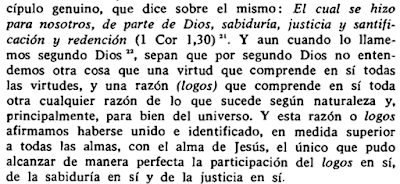
¿Era Orígenes es trinitario? ¿Reflejaba en sus escritos la doctrina de la trinidad?

¿Era Orígenes es trinitario? ¿Reflejaba en sus escritos la doctrina de la trinidad?
Antes de comenzar, a continuación algo que tomar en cuenta al momento de leer de la traducción al Latín de Rufinus de una de las obras de Orígenes más difundidas (el énfais en negrita es agregado por mí):

"And therefore, that I might not find you too grievous an exactor, I gave way, even contrary to my resolution; on the condition and arrangement, however, that in my translation I should follow as far as possible the rule observed by my predecessors, and especially by that distinguished man whom I have mentioned above, who, after translating into Latin more than seventy of those treatises of Origen which are styled Homilies and a considerable number also of his writings on the apostles, in which a good many “stumbling-blocks” are found in the original Greek, so smoothed and corrected them in his translation, that a Latin reader would meet with nothing which could appear discordant with our belief." (Prologue of Rufinus, ANTE-NICENE FATHERS VOLUME 4. Translated by the Rev. Frederick Crombie, D.D.)

Rufinus o Rufino de Aquilea (345-411 E.C. ) fue uno de los traductores mediante el cual tenemos algunos escritos completos de Orígenes, los cuales fueron traducidos al Latín por este. Vale la pena remarcar, que siendo este doctrinalmente trinitario, y como él lo admite en su prólogo, al encontrar pasajes los cuales refuten o contradigan su creencia, este los ‘corregía’ o adulteraba, por lo tanto en la mayoría de los casos se citará de traducciones de los fragmentos existentes del trabajo en la lengua original griega de Orígenes, y no de las traducciones que partieron del Latín del Rufinus, el cual contenía enmendaciones, adulteraciones y adiciones acomodadas a la doctrina del traductor. Aun así los fragmentos existentes son pocos, y no se puede determinar realmente cuanta fue la magnitud de las modificaciones, y en que partes fueron hechos los cambios del traductor a las obras de Origenes.

"But the truth is that no one who had nothing to go upon except the innocent-looking prefaces of Rufinus would have the least conception of the scope of the changes which he made. There are not only long additions and omissions, but mistranslations, some deliberate, some perhaps unconscious, paraphrases in which must be studied in detail before their cumulative effect can be appreciated. After gathering every Greek fragment that can be found there is less than one-sixth of the original work available by which to check Rufinus. Included in this proportion are the most controverted, and therefore the more seriously altered, parts of the work.” (Origen on First Principles, Being Koetchau's Text of the De Principiis Translated into English, Together with an Introduction and Notes by G. W. Butterworth, pg. xivii, 1966)

        ¿Creía Orígenes que Jesucristo (o la Sabiduría, Palabra, Logos) era el mismo Dios que el Padre, u otro dios/Dios?

(ORIGENES Contra Celso
, Biblioteca de Autores Cristianos, LA EDITORIAL CATOLICA S.A., Pg. 366, 1967)

¿Quién es el único  personaje que no es creado para Orígenes?

(On First Principles, Libro I, cap 3, G. W. Butterworth, pg. 51, 2012)

(Origen on First Principles, Volume I, John Behr, pg. 49, 2017)


Orígenes: Diálogo con Heráclides:

Origen said: Since once an inquiry has begun it is proper to say something upon the subject of the inquiry, I will speak. The whole church is present and listening. It is not right that there should be any difference in knowledge between one church and another, for you are not the false church. I charge you, father Heraclides: God is the almighty, the uncreated, the supreme God who made all things. Do you hold this doctrine?
Heracl.: I do. That is what I also believe.
Orig.: Christ Jesus who was in the form of God, being other than the God in whose form he existed, was he God before he came into the body or not?
Heracl.: He was God before.
Orig.: Was he God before he came into the body or not?
Heracl.: Yes, he was.
Orig.: Was he God distinct from this God in whose form he existed?
Heracl.: Obviously he was distinct from another being and, since he was in the form of him who created all things, he was distinct from him.
Orig.: Is it true then that there was a God, the Son of God, the only begotten of God, the firstborn of all creation, and that we need have no fear of saying that in one sense there are two Gods, while in another there is one God?
Heracl.: What you say is evident. But we affirm that God is the almighty, God without beginning, without end, containing all things and not contained by anything; and that his Word is the Son of the living God, God and man, through whom all things were made, God according to the spirit, man inasmuch as he was born of Mary.
Orig.: You do not appear to have answered my question. Explain what you mean. For perhaps I failed to follow you. Is the Father God?
Heracl.: Assuredly.
Orig.: Is the Son distinct from the Father?
Heracl.: Of course. How can he be Son if he is also Father?
Orig.: While being distinct from the Father is the Son himself also God?
Heracl.: He himself is also God.
Orig.: And do two Gods become a unity?
Heracl.: Yes.
Orig.: Do we confess two Gods?
Heracl.: Yes. The power is one.
Orig.: But as our brethren take offence at the statement that there are two Gods, we must formulate the doctrine carefully, and show in what sense they are two and in what sense the two are one God. Also the holy Scriptures have taught that several things which are two are one. And not only things which are two, for they have also taught that in some instances more than two, or even a very much larger number of things, are one. Our present task is not to broach a problematic subject only to pass it by and deal cursorily with the matter, but for the sake of the simple folk to chew up, so to speak, the meat, and little by little to instill the doctrine in the ears of our hearers. . . . Accordingly, there are many things which are two that are said in the Scriptures to be one. What passages of Scripture? Adam is one person, his wife another. Adam is distinct from his wife, and his wife is distinct from her husband. Yet it is said in the story of the creation of the world that they two are one: "For the two shall be one flesh." Therefore, sometimes two beings can become one flesh. Notice, however, that in the case of Adam and Eve it is not said that the two shall become one spirit, nor that the two shall become one soul, but that they shall become one flesh. Again, the righteous man is distinct from Christ; but he is said by the apostle to be one with Christ: "For he that is joined to the Lord is one spirit." Is it not true that the one is of a subordinate nature or of a low and inferior nature, while Christ's nature is divine and glorious and blessed? Are they therefore no longer two? Yes, for the man and the woman are "no longer two but one flesh," and the righteous man and Christ are "one spirit." So in relation to the Father and God of the universe, our Saviour and Lord is not one flesh, nor one spirit, but something higher than flesh and spirit, namely, one God. The appropriate word when human beings are joined to one another is flesh. The appropriate word when a righteous man is joined to Christ is spirit. But the word when Christ is united to the Father is not flesh, nor spirit, but more honorable than these —God. That is why we understand in this sense "I and the Father are one." When we pray, because of the one party let us preserve the duality, because of the other party let us hold to the unity. In this way we avoid falling into the opinion of those who have been separated from the Church and turned to the illusory notion of monarchy, who abolish the Son as distinct from the Father and virtually abolish the Father also. Nor do we fall into the other blasphemous doctrine which denies the deity of Christ. What then do the divine Scriptures mean when they say: "Beside me there is no other God, and there shall be none after me," and "I am and there is no God but me"? In these utterances we are not to think that the unity applies to the God of the universe . . . in separation from Christ, and certainly not to Christ in separation from God. Let us rather say that the sense is the same as that of Jesus' saying, "I and my Father are one." (https://sites.google.com/site/demontortoise2000/Home/origen_dialog_with_heracleides)

"In the same way, therefore, I consider that in the case of the Savior it would be right to say that he is an image of God's goodness, but not goodness itself. And perhaps also the Son, while being good, is yet not good purely and simply. And just as he is the image of the invisible God, and in virtue of this is himself  God, and yet is not he of whom Christ himself says, 'that they may know thee, the only true God'; so he is the image of goodness, and yet not, as the Father is, good without qualification." (Origen on First Principles, Being Koetchau's Text of the De Principiis Translated into English, Together with an Introduction and Notes by G. W. Butterworth, pg. 27, 1966)

¿Orígenes oraba en un sentido trinitario?, o ¿solo oraba al Padre?

Planteamiento trinitario sobre la oración:
"We pray to Christ... Because of the perichoresis (mutual indwelling), each member of the Trinity is fully present in the being and acts of the others. A prayer to Christ is also a prayer to the Father and vice versa." (God the Almighty: Power, Wisdom, Holiness, Love, Donald G. Bloesch, Theological Seminary in Dubuque, pg. 193, 2005)

Orígenes en la oración:
“Yet if we are offer thanksgiving to men who are saints, how much more should we give thanks to Christ, who has under the Father’s will conferred so many benefactions upon us? Yes and intercede with Him as did Stephen when he said, “Lord, set not this sin against them.” In imitation of the father of the lunatic we shall say, “I request, Lord, have mercy” either on my son, or myself, or as the case may be. But if we accept prayer in its full meaning, we may not ever pray to any begotten being, not even to Christ himself, but only to the God and Father of All to whom our Savior both prayed himself, as we have already instanced, and teaches us to pray. For when He has heard one say. “Teach you us to pray,.” He does not teach men to pray to Himself but to the Father saying, “Our Father in heaven,.” and so on. For if, as is shown elsewhere, the Son is other than the Father in being and essence, prayer is to be made either to the Son and not the Father or to both or to the Father alone. That prayer to the Son and not the Father is most out of place and only to be suggested in defiance of manifest truth, one and all will admit. In prayer to both it is plain that we should have to offer our claims in plural form, and in our prayers say, “Grant you both, Bless you both, Supply you both, Save you both,.” or the like, which is self-evidently wrong and also incapable of being shown by anyone to stand in the scriptures as spoken by any. It remains, accordingly, to pray to God alone, the Father of All, not however apart from the High Priest who has been appointed by the Father with swearing of an oath, according to the words He hath sworn and shall not repent, “You art a priest forever after the order of Melchizedek.” In thanksgiving to God, therefore, during their prayers, saints acknowledge His favors through Christ Jesus.”  (Origen on Prayer, chapter X,  pg.  25, http://www.ccel.org/ccel/origen/prayer.html)

¿Padre, hijo y espíritu santo, son iguales en poder?

"The God and Father, who holds the universe together, is superior to every being that exists, for he imparts to each one from his own existence that which each one is; the Son, being less than the Father, is superior to rational creatures alone (for he is second to the Father); the Holy Spirit is still less, and dwells within the saints alone. So that in this way the power of the Father is greater than that of the Son and of the Holy Spirit, and that of the Son is more than that of the Holy Spirit, and in turn the power of the Holy Spirit exceeds that of every other holy being." De la versión en Griego, esta parte es omitida intencionalmente por Rufino en su traducción al Latín, Libro I, Cap 3  (Origen on First Principles, Being Koetchau's Text of the De Principiis Translated into English, Together with an Introduction and Notes by G. W. Butterworth, pg. 34,35, 1966)

"Following the same reasoning we believe that everything whatever except the Father and God of the Universe is created." (Origen on First Principles, Being Koetchau's Text of the De Principiis Translated into English, Together with an Introduction and Notes by G. W. Butterworth, pg. 31, 1966)

Según Justiniano: "'that he (i.e. Origen) called the Holy Spirit a created being, as well as the Son, and included them in the number of the other created beings; and accordingly he terms them "ministering creatures".'" (Mansi IX, 528)

“We consider, therefore, that there are three hypostases, the Father and the Son and the Holy Spirit; and at the same time we believe nothing to be uncreated but the Father. “ ((Book 2, Chapter 6, “Origen's Commentary on the Gospel of John,” Translated by Allan Menzies. From Ante-Nicene Fathers, Vol. 9. Edited by Allan Menzies. Buffalo, NY: Christian Literature Publishing Co., 1896.)

¿Para Origenes, era Cristo creador?

Punto de vista trinitario:

“Como vimos en el capítulo anterior, Cristo es nuestro creador” (Cristo Nuestra Vida, David F. Burt, 13 años de Pastor Evangélico,  pg. 59, 2006)

“Christ is creator as the Father is Creator” (An Introduction to Roman Catholicism, Enrique Fiesta, John Davidson ,pg. 7, 2015)


Contraste:


“And the Apostle Paul says in the Epistle to the Hebrews: At the end of the days He spoke to us in His Son, whom He made the heir of all things, 'through whom' also He made the ages, showing us that God made the ages through His Son, the through whom belonging, when the ages were being made, to the Only-begotten. Thus, if all things were made, as in this passage also, through the Logos, then they were not made by the Logos, but by a stronger and greater than He. And who else could this be but the Father?” (Commentary on the Gospel of John, Ante-Nicene Fathers, Vol. 9. Edited by Allan Menzies Book II, chapter 6)


Sobre el espíritu santo:

"Y el Apóstol Pablo dice en la Epístola a los Hebreos: "Al final de los días nos habló en Su Hijo, a quien hizo heredero de todas las cosas, 'por quien' también hizo las edades", mostrándonos que Dios hizo los siglos por medio de su Hijo, el "a través del cual" pertenecía, cuando se estaban haciendo los siglos, al Unigénito. Así, si todas las cosas fueron hechas, como también en este pasaje, a través del Logos, entonces no fueron hechas por el Logos, sino por uno más fuerte y más grande que Él. ¿Y quién más podría ser éste sino el Padre? Ahora bien, si, como hemos visto, todas las cosas fueron hechas por medio de Él, tenemos que preguntarnos si también el Espíritu Santo fue hecho por medio de Él. Me parece que aquellos que sostienen que el Espíritu Santo fue creado, y que también admiten que "todas las cosas fueron hechas por medio de Él", deben necesariamente suponer que el Espíritu Santo fue hecho por medio del Logos, siendo el Logos, en consecuencia, más antiguo que Él. Y quien se resiste a permitir que el Espíritu Santo haya sido hecho por medio de Cristo debe, si admite la verdad de las afirmaciones de este Evangelio, suponer que el Espíritu es increado. Hay un tercer recurso además de estos dos (el de dejar que el Espíritu haya sido hecho por la Palabra, y el de considerarlo como increado), a saber, afirmar que el Espíritu Santo no tiene esencia propia más allá del Padre y del Hijo. Pero pensándolo mejor, quizás uno pueda ver la razón para considerar que el Hijo es el segundo después del Padre, siendo Él lo mismo que el Padre, mientras que manifiestamente se hace una distinción entre el Espíritu y el Hijo en el pasaje, Mateo 12:32 "Todo aquel que hablare una palabra contra el Hijo del Hombre, le será perdonado, pero cualquiera que blasfemare contra el Espíritu Santo, no tendrá perdón, ni en este mundo ni en el venidero”. Consideramos, pues, que hay tres hipóstasis, el Padre y el Hijo y el Espíritu Santo; y al mismo tiempo no creemos que haya nada increado sino el Padre. Nosotros, por tanto, como los más piadosos y los más verdaderos camino, admitimos que todas las cosas fueron hechas por el Logos, y que el Espíritu Santo es el más excelente y el primero en el orden de todo lo que fue hecho por el Padre a través de Cristo. Y esta, quizás, es la razón por la que no se dice que el Espíritu sea el propio Hijo de Dios. El Unigénito solo es por naturaleza y desde el principio Hijo, y el Espíritu Santo parece tener necesidad del Hijo, para ministrarle su esencia, a fin de capacitarlo no solo para existir, sino para ser sabio y razonable, y justo, y todo lo que debemos pensar de Él como ser."
Comentario de Orígenes al evangelio de Juan, libro II, https://www.newadvent.org/fathers/101502.htm

Hoy me di un tiempito y subí este artículo que aun esta en desarrollo, no quería dejarlo guardado sin ser útil, por lo tanto decidí publicarlo tal como está, con el tiempo espero completarlo (realmente tengo poco tiempo para hacerlo), gracias por su paciencia y espero que les sea útil, saludos :). 

sábado, 17 de diciembre de 2011

Los Cristianos Ante-Nicemos o padres apostólicos (siglos II-III) y la trinidad


Los Cristianos Ante-Nicemos o padres apostólicos (siglos II-III) y la trinidad

Si las escrituras y los primeros cristianos enseñaban o daban a entender una doctrina de la trinidad, sin duda los cristianos que vinieron inmediatamente después también la enseñarían, por este motivo es útil analizar qué era lo que pensaban sobre la identidad de Dios:

Justin Martir:

Este personaje nació en Samaria alrededor del año 100 y murió como mártir en el año 165 (A.D).
Su testimonio es muy importante puesto que Justino llegó a ser discípulo del apóstol Juan, este pudo conocerlo directamente, y estaba bajo directa influencia de sus enseñanzas, si Dios era una trinidad, no habría nadie más confiable a quién preguntarle después que murieron los apóstoles. Analicemos entonces uno de sus escritos:

“and is subordinate to God the Creator of all things, was born of a Virgin, and was made Man of the like passions with all other men, as you said before.” (Justin Martyr’s Dialogue with Tripho the Jew, pg. 229)

Como leemos para Justino Jesús estaba subordinado a Dios, en otras palabras para él, Dios no era igual a Cristo, Dios era superior a Cristo, haciendo imposible la idea de la co-igualdad que propone la doctrina de la trinidad.

"the views of Justin Martyr on the subject of the Son and Spirit, showing that they were not Trinitarian in any legitimate sense of the term."(The church of the first three centuries: or, notices of the lives and opinions of the early fathers, Escrito por Alvan Lamson, D.D., pg. 78, 1860)

"Doctrine of the Trinity Justine had none.... The Logos was divine, but in the second place; the Holy Spirit was worthy of worship, but in third place. Such words are entirely incompatible with a doctrine of the Trinity"(The Theology of Justin Martyr, Erwin R. Goodenough, pg. 186, 2009)

"Justin had no real doctrine of the Trinity" (Justin Martyr: His life and Thought, Cf. Leslie W. Barnard, pg. 105, 1967)

Sucede algo parecido con sus contemporáneos:

Tatian the Syrian or Assyrian:

"Logos leaped out from him; being his first-begotten work," (Ante Nicene Chrsitian Library, Translations of the writings of the fathers, Vol. III, The writings of Tatian and Theophilus, and the Clementine Recognitions, pg. 9)


Theophilus, Bishop of Antioch

"God, when about to make those things he had designed, begat this Logos; producing, or throwing him out, the first-born of every creature." (Ad Autol., 1. ii. i. 365, 355)

Ireneo Lyón


“...Christ says ( by ) David ... He properly says other things ( of ) Himself ( by ) the prophets [...] who created me his servant from the womb […] I will be glorified before THE LORD AND MY GOD...” (The Proof of Apostolic Preaching, Translated By Karapet Ter Mekerttschian & S. G. Wilson from the Armenian text, Chapter 50, 1919.)

"that we might learn from him that theover all; for 'the Father,' he says, 'is greater than I'." (Ib., e. 49.)

Tertulian:

"The Father is different from the Son (another), as he is greater; as he who begets is different from him who is begotten; he who sends, different from him who is sent; he who does a thing, different from him by whom (as an instrument) it is done." (Ib., e. 9.)
Nótese que aun que Tertuliano utilizaba el término trinidad, lo hacía con un significado muy diferente al de la actual definición, ya que el significado actual del término y el hecho de que Tertuliano creyera que Dios es superior a Jesucristo no concuerdan. Tertuliano creía que el Padre y el Hijo eran de la misma sustancia, pero no veía como coigual la deidad del hijo respecto a la deidad del Padre: "Pater enim tota substantiaest Filius vero, derivatio totius et portio..." ("Por que el Padre es toda la sustancia, pero el Hijo es una derivación y una parte del total..." Contra Praxeas 9.2 (A).


Lactancio:

"The third step is to know His Servant and Messenger, whom He sent as His ambassador to the earth, by whose teaching being freed from the error in wich we were held entagled, and formed to the worship of the true God, we might learn righteousness." (A Treatise on the anger of God, Chap. II, Lactantius)

Clement of Alenjandria:

“Conozcan todos los pueblos que Tú eres el solo Dios, y Jesucristo tu Hijo y Siervo” (Padres Apostólicos, páginas 177, 216, 237.)
Clemente de Alejandría: Protréptico 120.2: "¡Estas son las fiestas báquicas de mis misterios! Si quieres, iníciate también tú, y participarás en el coro de los ángeles, en torno al único Dios verdadero, al ingénito e imperecedero; con nosotros canta el Logos de Dios."

Origens:
"The Father, who sent him (Jesus), is alone good, and greater than he who was sent." (Ib., t. ; 28)
"el Espíritu Santo es el mas honorable de todas las cosas hechas por medio de la Palabra, y ... el es primero en rango de todas las cosas que fueron hechas por el Padre mediante Cristo." (Origenes Comentario sobre Juan, Libro II)

Novatian:

"Whatever the Son is, he is not of himself, because he is not self-existent. Whatever we style him, whether the Word, or the Power, or the Wisdom, or the Light, or the Son, yet, whatever he is, he is no otherwise than from the Father." (Novatian)


The Didache, or Teaching of the Twelve (Apostles)

El didajé es un manual de conducta Cristiana que data alrededor del año 150 E.C., y qun que su o sus autores no se conocen refleja las creencias fundamentales que hallamos en la Biblia y se considera un documento extra-bíblico muy importante, veamos que nos plantea sobre la relación Dios-Cristo:

“Después de saciaros, daréis gracias de este modo:
Te damos gracias, Padre nuestro, por tu Santo nombre, que hiciste morar en nuestros corazones, y por el conocimiento, la fe y la inmortalidad que nos manifestaste por medio de Jesús, tu siervo…. Y vida eterna por tu siervo.” (Didajé, Cap. 10)

Si buscamos alguna explicación relacionada a la trinidad nos hallaremos decepcionados, puesto que en este documento hallamos la misma idea bíblica que nos presenta un Jesucristo como siervo de Dios, no así como su igual.


"The "apologists," the first great sequence of postbiblical theologians from
Justin Martyr at the middle of the second century to Origen at the middle of the
third, built and worked within a subordinationist theological structure. (Systematic Theology, Volume I, The Triune God, Robert W. Jenson, pg. 96, 1997)

En resumen podemos concluir que aun que las creencias de todos estos cristianos de primeros siglos diferían en algunos aspectos, en general, estaban de acuerdo con el concepto bíblico de que Dios (Jehová) es la deidad suprema creadora del universo (Dios de dioses), y que Jesucristo (Logos) es su hijo, su siervo, el primera y amada creación  (Dios y el Logos o palabra o Jesucristo no son co-iguales, concepto necesario para poder hacer referencia a la doctrina de la trinidad). Todo esto sirve de testimonio para demostrar que la doctrina de la trinidad no la enseñaron ni Jesús ni sus apóstoles, ni los cristianos de siglos inmediatamente posteriores. El análisis de este tema continúa en el siguiente artículo. Clic aquí